
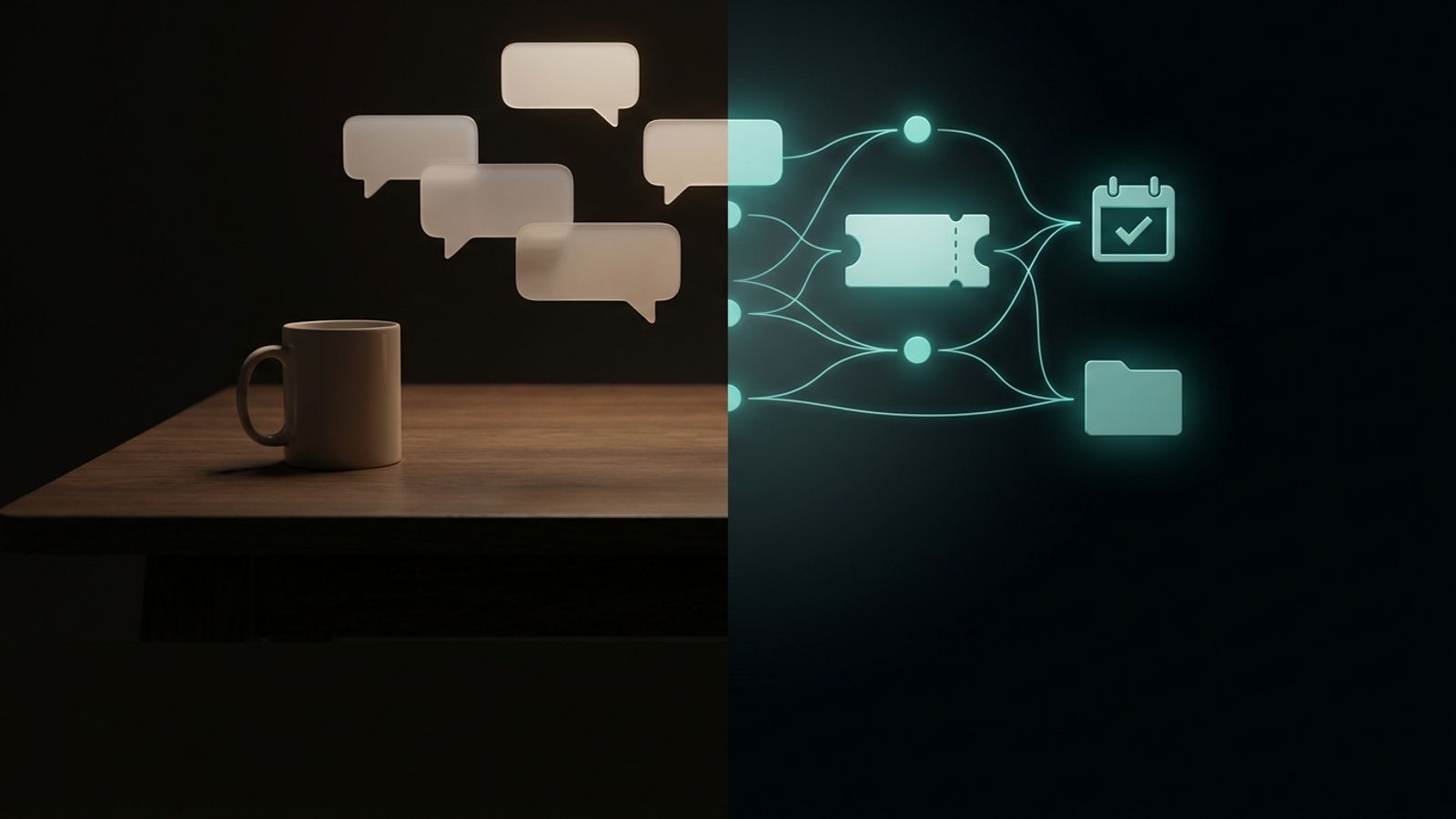
A chatbot answers questions. An AI agent takes actions — it looks things up, writes to systems, and moves work forward. If your “AI” only returns text and never changes a record, you have a chatbot, no matter what the vendor called it.
That distinction matters because the wrong layer wastes money: agents without clean processes fail loudly; chatbots on revenue-critical workflows leave humans doing the real work after every reply.
Are AI agents the same as chatbots?
No. Both may use language models. The difference is authority and side effects.
- Chatbot: retrieves or generates an answer. Side effect: a message.
- Agent: plans steps, calls tools (CRM, POS, calendar, email, ERP), and updates state. Side effects: bookings, tickets, drafts, status changes.
A chatbot can sit in front of an agent. The chat UI is the interface; the agent is the worker behind it.
Quick decision tree
Start here:
- Is success “the customer got a clear answer”? → Chatbot (or search + FAQ) is enough.
- Is success “a system of record changed without a human copy-paste”? → You need an agent (or classic automation).
- Does the flow need judgment under ambiguity and tool use? → Agent with human-in-the-loop.
- Is the process still chaotic and undocumented? → Fix the process first; neither layer will save you.
Side-by-side: chatbot vs agent
Chatbot wins when intent is informational: hours, policies, product FAQs, status lookups with a safe read-only API. Agents win when work must finish: place an order, book a visit, qualify and log a lead, triage an exception into the right queue.
Cost and risk rise with write access. Agents need permissions, audit trails, and failure handling — the same bar we hold on AI agent development.
Three production examples
Restaurant ordering: a FAQ bot that lists the menu is a chatbot. A system that takes the order, confirms modifiers, and writes into POS — like Concierge on Naija Jollof — is an agent wrapped in conversation.
Sales follow-up: answering "what's your pricing?" is chatbot territory. Researching the lead, drafting outreach, logging activity, and booking the meeting is agent territory — the layer Flowforce is built around.
Ops exceptions: explaining a delay policy is a chatbot. Opening the exception, pulling shipment state, and routing a human the right packet is an agent.
When NOT to build an agent
- The process changes weekly and nobody owns the source of truth
- Write access would touch money, inventory, or customer PII before you have approvals and logging
- A static FAQ or search would resolve most tickets
- You are buying "agent" branding for what is still a prompt over a PDF
If you are still deciding whether automation is even justified, start with how we measure automation ROI - not with model shopping.
FAQ
When should you build an AI agent?
When a repeatable workflow needs judgment plus tool use, and leaving it to humans creates delay, error, or lost revenue. When the answer alone is the outcome, ship a chatbot first.
Can a chatbot become an agent later?
Yes - keep the conversational front end and add tool calls, permissions, and monitoring behind it. Design for that path early so you do not rebuild the channel.
Not sure which layer you need? Book a demo and we will map the thinnest system that finishes the work.